Ste. Odile Hospital
All My Puny SorrowsSte. Odile Hospital is where a family already marked by suicide and loss confronts two crises at once: Elfrieda Von Riesen’s hospitalization after a suicide attempt and Tina Loewen’s sudden, ultimately fatal heart emergency. Its intensive-care rooms, psychiatric ward, waiting areas, and underground car park form a connected landscape of vigil and uncertainty. The hospital offers treatment and the possibility of survival, but it also becomes a place where relatives struggle to be heard, to interpret one another, and to understand what care can promise.
A hospital divided between intensive care and psychiatry
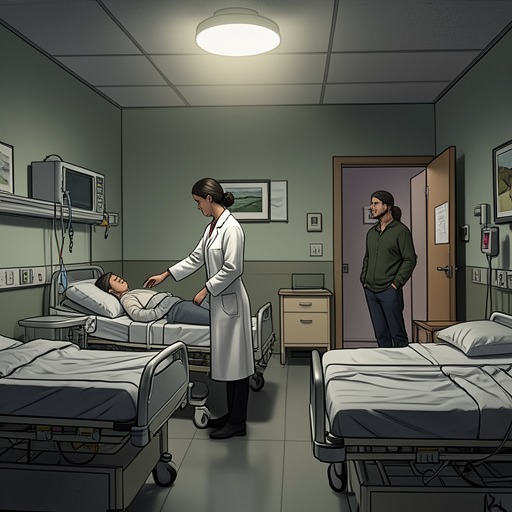
Elf arrives at Ste. Odile Hospital in critical condition. In intensive care, a tube in her throat and a breathing machine make her survival visible while temporarily limiting her ability to speak. Nic tells Yolandi that Elf will probably live, although the doctors still need time to determine the extent of possible organ damage and whether her throat will affect her speech. The provisional prognosis brings relief without ending the family’s uncertainty: the immediate danger may pass, but the consequences remain unknown.
The hospital’s layout becomes part of the family’s effort to keep track of both sisters. Later, Yolandi and Lottie cannot find Elf in intensive care; a nurse tells them she has been transferred to Psych 2 in the Palaveri Building, several buildings away across the hospital grounds. The move makes the separation between emergency medical treatment and psychiatric care concrete. Elf has survived the immediate physical crisis, but her care now continues elsewhere on the campus.
Family vigil and overlapping emergencies
The hospital gathers Elf’s relatives and friends around her bed. Nic is there, as are Yolandi, Lottie, Tina, and Julie. Because only two visitors may enter at a time, they take turns going in. Will calls from a distance and struggles to deliver a message, finally managing to tell Yolandi that he loves Elf. At the bedside, Julie and Yolandi hold Elf’s hands; Elf communicates through gestures, including tapping her forehead, whose meaning Yolandi cannot confidently interpret. Their presence matters even when words fail, but the scene leaves the family unsure how much they can understand of Elf’s experience.
The intensive-care vigil also brings the family’s history of bereavement into the present. Lottie arrives with Tina, her sister, and the two women embrace Yolandi without needing to explain why they have come. Tina had lost her daughter Leni to suicide seven years earlier, three years after Yolandi and Elf’s father died by suicide. The family recognizes the hospital crisis as another recurrence of loss, even before it knows the outcome. Lottie’s arm bears marks from a dog bite, a further sign of the strain surrounding the emergency, while Nic supports her after she visits Elf.
Tina’s own condition worsens during this period. When Yolandi and Lottie return to the hospital, they learn Tina will need open-heart surgery to prevent a major coronary event. Notes on Tina’s cast record appointments and activities she must cancel, small plans displaced by the sudden medical emergency. The nurse presents the operation as routine and expects Tina to recover; this reassurance helps explain why the family is unprepared for what follows. The surgery initially appears successful, and the doctor comes out smiling to report that it went well. Then Tina’s organs begin to fail. The medical team cannot save her, and her death leaves Lottie without her last sibling and closest sister. The hospital gives the family a sequence of changing expectations, from a routine operation to irreversible loss.
Communication, treatment, and the limits of listening
Ste. Odile Hospital is also the setting for a conflict over how Elf is expected to communicate. Janice, a staff member who wants Elf to make eye contact, encounters her silence and reluctance. Elf is angry with herself for having failed, but tries to follow her personal commitment to good form. Yolandi remembers that Elf had once relied on the word love as a guiding principle, only to find that repeating it could intensify her distress. Their differing responses to language reveal a tension between Elf’s need to work through experience in her own way and the family’s wish for a usable explanation.
Elf gives Yolandi a vivid account of an imagined glass piano inside her body: an old upright Heintzman, entirely made of glass, whose sounds she fears might signal breakage. A child’s laughter in the hospital is mistaken for the sound of shattering glass. The image makes Elf’s fear communicable, even though it is not a literal medical description. Elsewhere, Janice describes art therapy as a way patients can express themselves more readily through paint and paper than through speech. Yolandi, overwhelmed and unable to explain how she is doing, sits with Janice’s hand on her shoulder and wonders about the medication Elf is receiving and what it may be doing to her experience of life.
That question of communication becomes sharper when Yolandi asks to speak with Elf’s psychiatrist. The psychiatrist says he has tried to speak with Elf, but she would not speak; Yolandi explains that Elf is sometimes willing to write things down. He dismisses the practical value of reading her writing while working and says that getting better will require her to make an attempt to communicate normally. The exchange exposes a mismatch between Elf’s available means of expression and the clinician’s stated expectation. In the same hospital setting, art therapy recognizes that language is not the only route to expression, while the psychiatrist insists on ordinary communication as a condition of improvement.
Decisions and consequences beyond the ward
Yolandi’s questions about Elf’s treatment are bound up with the request that she take Elf to Switzerland for assisted death. She refuses, objecting to the idea of treating the trip as a final act, but later researches the Swiss legal position and learns that assisted suicide may be available to people who are not Swiss citizens, including people experiencing mental illness. She considers whether a lawful route in Zurich might be possible, while recognizing that agreement from Nic and Lottie and a medical assessment would matter. Julie remains uncertain and argues that the option is meant for people who are dying already. These conversations show how the hospital crisis extends beyond medical prognosis: survival does not settle the question of what Elf wants or what her family should do.
Yolandi’s distress also spills into the hospital’s less intimate spaces. In the underground car park, while trying to park near the intensive-care entrance, she confronts a man who warns her about damaging his car. She responds by explaining that she is about to go upstairs to find out whether her sister is alive. The encounter turns an ordinary parking dispute into a measure of how entirely the emergency has altered her sense of proportion. Across the hospital, the family moves between bedside silence, clinical conversations, legal and moral uncertainty, and a second medical crisis whose apparent promise of recovery ends in death. Ste. Odile Hospital is significant not because it resolves these conflicts, but because it concentrates them: care is urgently present, yet understanding and reassurance remain partial.